Building AI-Powered Career Verticals with University of Florida College of Nursing
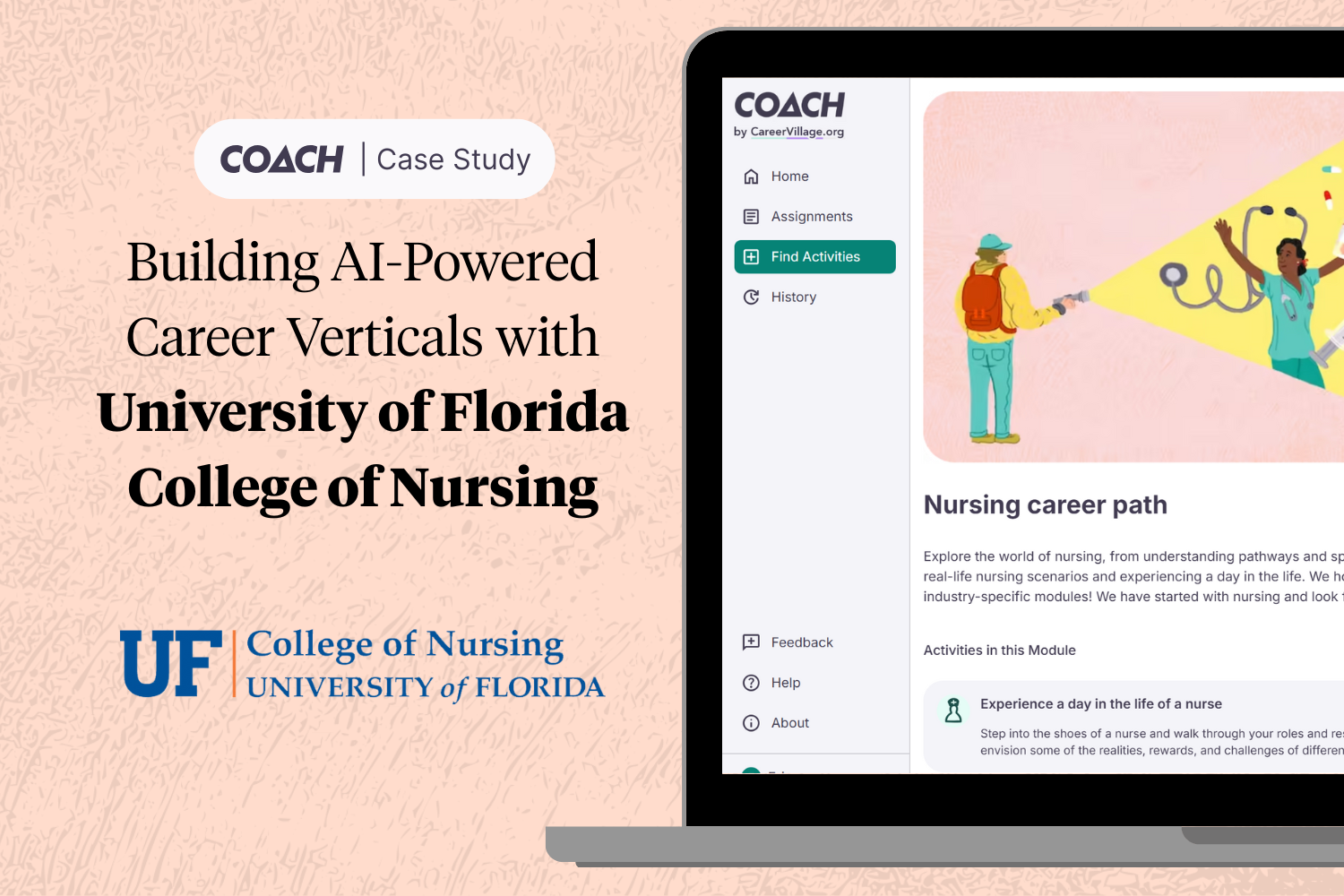
Lessons from developing Coach for Nurses
AI-powered career guidance is still in its infancy. While its potential is enormous, real-world implementation is an evolving process—one that requires deep collaboration with institutions, ongoing iteration, and a willingness to learn in public.
At CareerVillage, we see ourselves as both builders of AI career coaching and early explorers in a space still defining itself. Developing Coach for Nurses—our first industry-specific AI career vertical—was an experiment in how AI can be adapted to serve distinct professional communities at scale.
This case study is meant to serve as an open reflection on what we’ve learned—what worked, what didn’t, and what remains unanswered. Our goal is to provide a transparent account of the challenges and insights that emerged from developing Coach for Nurses, in the hope that these lessons can inform future work in AI-driven career education.
Why career guidance needs to go vertical
Industry-specific AI career coaching must go beyond general career advice. It has to reflect the deeply embedded structures, language, and pathways of each profession.
Historically, career coaching has been broad and generalized. Many career tools and advising services offer high-level, industry-agnostic guidance, assuming that job seekers across fields face similar challenges.
But in professional domains like nursing, skilled trades, and emerging tech, career navigation is highly specialized. The difference between an ER nurse, a psychiatric nurse, and a public health nurse isn’t just a job title—it’s a fundamentally different career pathway, with unique education requirements, skill sets, and long-term growth trajectories.
When we began work on Coach for Nurses, we spoke with nursing students and professionals who described how difficult it was to get clear, specific career guidance.
At the same time, the scale of the challenge is growing at an unprecedented rate: the World Health Organization (WHO) estimates a global shortage of 4.5 million nurses by 2030. Current support networks can’t keep up with this growth, but with Coach for Nurses, we’re working to meet the challenge head-on.
The approach: Building a vertical-specific career AI
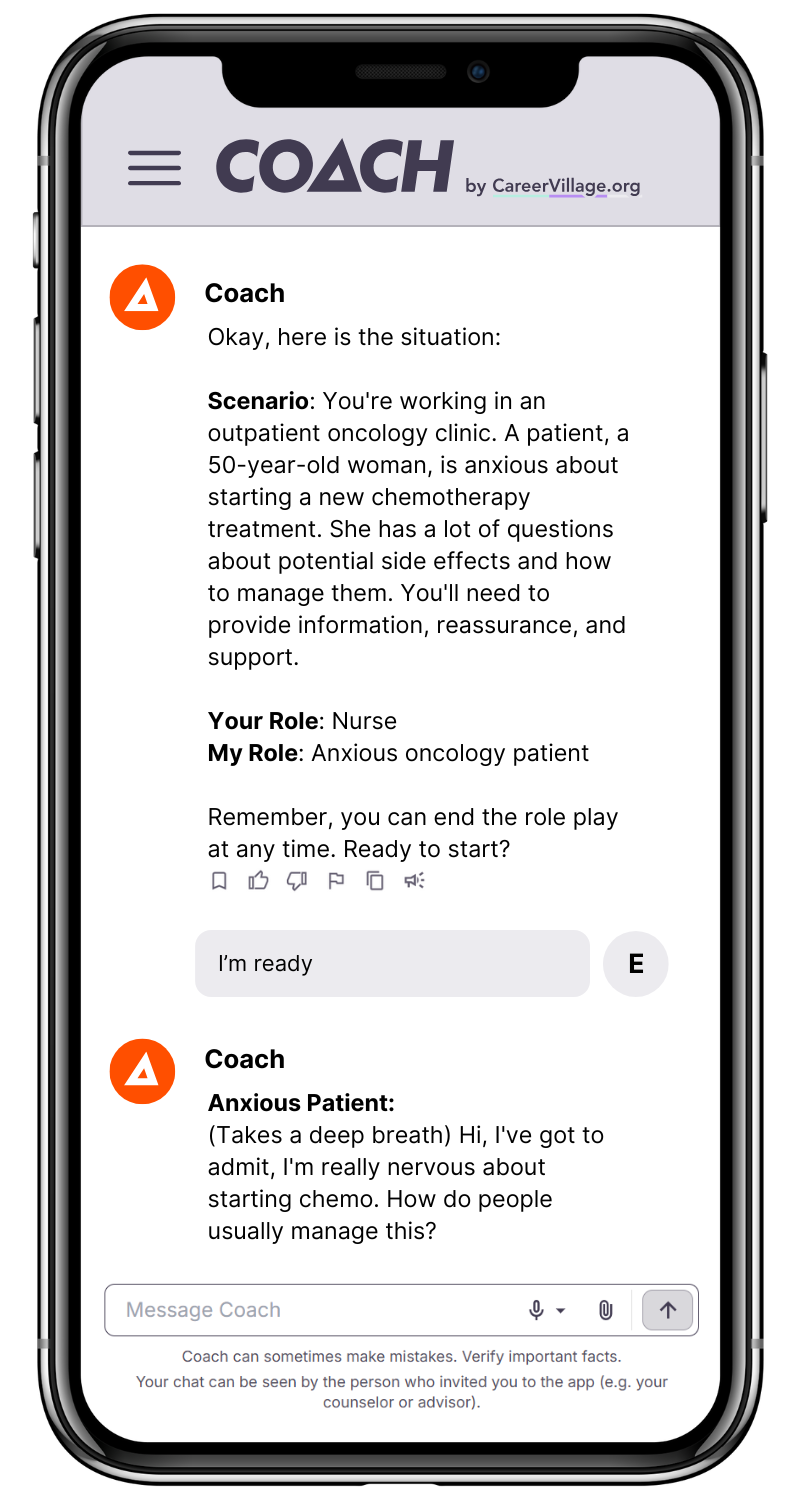
An example from the Simulate a Nursing Scenario activity
We set out to build Coach for Nurses as a test case for how AI-powered career coaching could be tailored to a single profession.
Rather than taking a one-size-fits-all approach, we focused on designing a nurse-centric experience that aligned with how nurses actually make career decisions. That meant:
- Using nursing-specific terminology and pathways instead of generic career advice.
- Developing structured, interactive career exploration activities to help users navigate specialization choices.
- Simulating real-world nursing scenarios, allowing users to explore different nursing roles through AI-driven conversations.
Our co-design process with nurses
To ensure that Coach for Nurses accurately reflected the realities of the profession, we engaged in a rigorous co-design process with the nursing community. In partnership with University of Florida College of Nursing, we conducted user feedback sessions with more than 100 nursing students, practicing nurses, and faculty members to refine the platform’s structure and content.
This included:
- Informational interviews with aspiring nurses to understand their biggest career navigation challenges.
- Testing sessions with experienced nurses to evaluate the accuracy and realism of simulated career experiences.
- Focus groups with faculty members to ensure alignment with nursing education and professional development frameworks.
This co-design process was instrumental in making Coach for Nurses a tool built by nurses, for nurses.
The bigger picture: what this means for the future of AI-powered career development tools
The development of Coach for Nurses has been a learning process, and it has reaffirmed our belief that AI-powered career coaching must be built in deep collaboration with institutions and industry professionals.
Our partnership with University of Florida College of Nursing was a major step in this process, providing invaluable testing opportunities and feedback. Their expertise helped shape the structure of Coach’s content, ensuring that the platform and product roadmap aligned with the evolving needs of both nursing learners and their educators.
For institutions, this case study highlights an opportunity: AI is not a replacement for human advising—it is a scalable tool that can expand access to high-quality, personalized career guidance.
For other AI developers in career edtech, our biggest takeaway is this: Personalization via high-quality data and institutional and industry partnerships is essential. Verticalization can be a replicable, effective strategy for scaling AI career coaching.
Join the Conversation
CareerVillage is committed to learning in public and working alongside educators, workforce leaders, and career development experts to refine AI-powered career guidance.
Let’s connect and shape the future of AI-powered career coaching together.
Our work to develop Coach for Nurses was generously funded by the Elisabeth C. DeLuca Foundation.
From the blog
Expanding Coach: A new partnership with NextLadder Ventures
The largest investment in CareerVillage to date will put career guidance within reach of more young people.
How Athens State Is Opening Doors to Career Coaching and AI for Adult Learners
Like most universities, Athens State has always had a Career Services office with an open-door policy. The challenge, however, is that career development is...
Coach Anywhere: Career Coaching, One Text Away
Introducing Coach Anywhere. Now learners can connect with Coach directly from their phones via text.